
I. What Are the Different Types of Web Design? A Comprehensive Overview of Common Web Design Styles
Depending on business objectives, industry characteristics, and user needs, web design has evolved into diverse formats and functional structures, such as single-page vs. multi-page, static vs. dynamic, and template-based vs. custom websites.Beyond visual design differences, these types also vary in terms of architectural planning, development complexity, and budget allocation. Below, we’ll guide you through the most common types of web design to help you quickly identify the website format that best suits your needs.
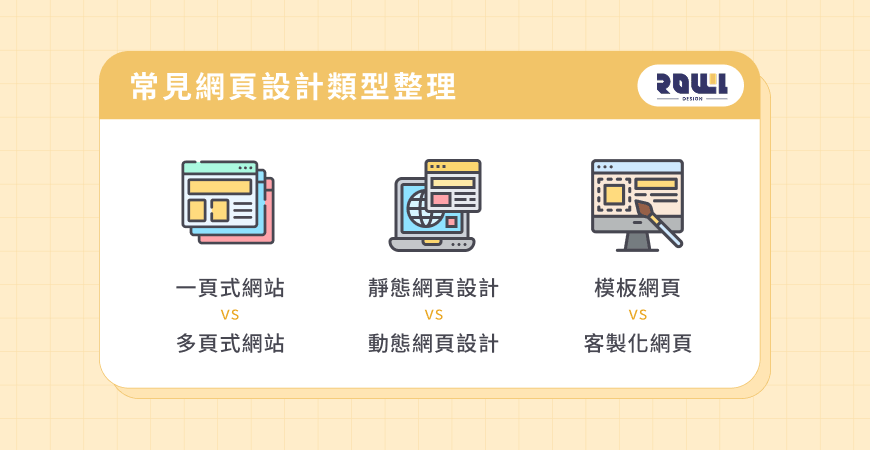
(1) Single-Page Websites vs. Multi-Page Websites
Single-Page Websites
A one-page website (One Page Website) consolidates all content onto a single page, allowing users to navigate between sections via scrolling or anchor links (which enable quick jumps to specific sections within the same page). Its advantages include a simple structure, fast development time, and the ability to effectively guide users through the content along a designed flow.However, if there is too much information, it may slow down loading times and is less favorable for SEO optimization.
● Suitable scenarios: Product introductions, event pages, or simple brand showcases.
Multi-page Website
A multi-page website (Multi-page Website) presents content across separate pages, such as a homepage, About Us page, product pages, and a blog. This structure is more comprehensive, allowing for clear categorization and expansion of information.
Since each topic has its own dedicated page, multi-page websites offer greater flexibility for content expansion and SEO management. However, development timelines and production costs are relatively higher, making them particularly suitable for corporate websites with a large volume of information or those requiring long-term maintenance.
● Suitable scenarios: E-commerce platforms, corporate websites, educational or service-oriented websites.
(2) Static Web Design vs. Dynamic Web Design
Static Web Design
Static web pages refer to websites where the page content is fixed and does not change based on user interactions; they are typically built using HTML and CSS. Their advantages include fast loading speeds and lower development costs, making them suitable for showcase sites or websites with simple information. However, if content updates are required, an engineer usually must modify the code, resulting in limited maintenance flexibility.
● Suitable scenarios: Showcase websites with minimal content, short-term event pages.
Dynamic Web Design
Dynamic web pages can display real-time changes based on user behavior or database content, such as membership systems and e-commerce sites. They are particularly suitable for official websites, blogs, or online stores that require frequent content updates. Although development costs are higher, they offer superior user experience and scalability, better meeting the modern web’s demands for interactivity and flexibility.
● Suitable scenarios: Blogs, forums, and e-commerce platforms.
(3) Template Websites vs. Custom Websites
Template Websites (Pre-built Websites)
Template websites are designed based on pre-existing layouts; they can go live quickly by simply inserting brand content, effectively shortening development time and offering relatively lower costs. Examples include websites built using website builders (such as WordPress or Wix). However, template websites may have limitations in terms of design flexibility and differentiation from competitors, making them more suitable for businesses with limited budgets or those needing to launch a website quickly.
● Suitable for: Startups, businesses with limited budgets, and those needing to launch a website quickly.
Custom Websites
Custom websites are planned and designed from scratch based on brand requirements. Everything from visual style and functional architecture to user experience can be tailored to the brand’s needs. This not only fully showcases the brand’s style and unique features but also helps enhance the website’s competitiveness. However, due to the higher level of customization required, development timelines are longer and costs are relatively higher, making this option more suitable for businesses that prioritize brand image and long-term growth.
● Ideal for: Large enterprises, e-commerce platforms, or professional service platforms.
Choose ROLLLL DESIGN LIMITED to help you plan the perfect website! Inquire Now
II. How Much Does Web Design Cost? An Explanation of Price Ranges and Factors Affecting Web Design Costs
Web design costs vary widely, ranging from simple template-based sites costing a few thousand dollars to custom platform-based websites costing hundreds of thousands or even millions. Below, we’ll break down common web design cost items, price ranges, and key influencing factors to help you better understand costs during planning and create a budget that meets your needs.
(1) Common Web Design Price Ranges
Web design costs vary depending on the website type, functional requirements, and development approach. Below are common pricing items and ranges found in the market, provided as a reference for budget planning:
| Item | Price |
|---|---|
Homepage | HKD 2,000 ~ 4,000 |
Internal Pages | HKD 1,000 ~ 2,000 (per page) |
Web Icons/Animations | Varies depending on design complexity |
Multilingual versions | Approx. 20%–30% of design fee |
(2) 4 Major Factors Affecting Website Development Costs
Website development costs are influenced by various factors, primarily including the complexity of page design, functionality and system integration requirements, server space specifications, and domain names. Therefore, it is recommended that brands comprehensively evaluate these items when planning their budget to accurately estimate total costs and make reasonable plans.
1. Number of Pages and Content Complexity
The number of pages, visual design, and the complexity of the user interface (UI) and user experience (UX) directly impact development costs. Additionally, if the website includes a large number of interactive effects, animations, or custom features, costs will increase accordingly due to the extended development time and heightened technical requirements.
2. Programming Features and System Integration
The more features a website requires, the higher the cost will be. For example, contact forms, membership systems, booking systems, shopping carts, or third-party API integrations all require additional development and testing, thereby increasing the overall website development cost.
3. Website Hosting and Server Space
Since a website must be hosted on a server to function, the server’s traffic capacity, stability, and security all impact the cost. Generally, websites with higher traffic or stability requirements need to select higher-spec server plans, which consequently increases the overall cost.
4. Domain Name Registration
Choosing the right domain name is crucial for brand visibility and long-term operations, as it serves as the website’s “online address.” If you opt for popular keywords or short, memorable domains, registration fees may be higher. Additionally, domains must be renewed periodically; if they expire, the website will become inaccessible and may be registered by others.
III. Hidden Costs in Web Development Pricing: 4 Major Additional Items You Can’t Ignore
When planning a website budget, in addition to basic design and development costs, there are often hidden costs that are easily overlooked. These include the development of specific features, the purchase of stock images or professional photography, ongoing maintenance and updates, as well as brand and marketing-related expenses. It is recommended that brands or businesses assess these additional costs early on to gain a more comprehensive understanding of the overall budget and avoid unexpected expenses later on.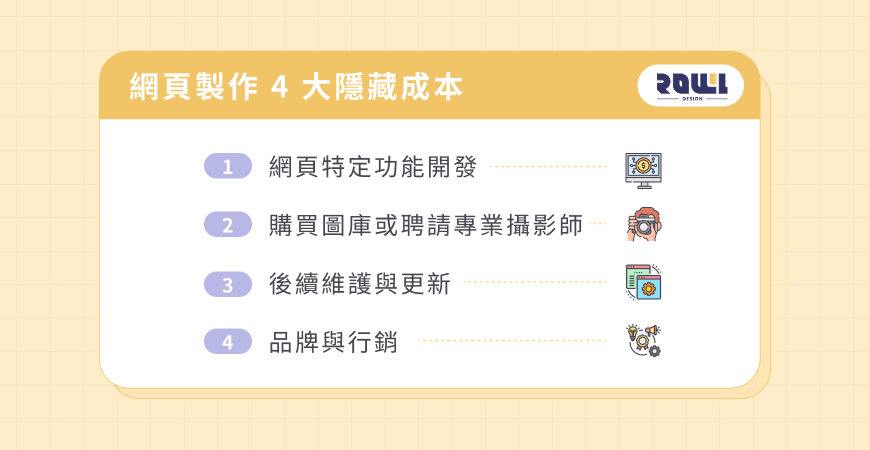
(1) Development of Specific Website Features
When a standard corporate website fails to meet business needs, the development of custom features is typically billed separately based on “logical complexity” and “difficulty of system integration.”Examples include multilingual switching systems, third-party payment integrations, or connections to internal corporate systems (ERP/CRM). Since such features often require professional programming and thorough testing, development difficulty and man-hours increase accordingly, and costs will vary based on complexity.
(2) Purchasing stock images or hiring a professional photographer
Visual assets for a website are also a cost that cannot be overlooked. If you choose to use licensed stock images, you will need to pay licensing fees; if you wish to present a unique brand image, hiring a professional photographer to shoot product or brand photos will also incur additional expenses.
● Stock Images: To avoid copyright disputes, you’ll need to purchase high-quality commercial images or subscribe to free stock image download sites.
● Professional Photography: If you need to showcase a unique corporate image, team portraits, or product studio shots, you will need to hire a photographer.
(3) Ongoing Maintenance and Updates
After the website goes live, regular maintenance and updates are still required to ensure security and stable operation. This includes software security updates, content adjustments, feature optimization, and system performance monitoring.
Generally, website maintenance is billed on an annual basis, with costs typically ranging from 10% to 20% of the total website development cost per year. Without a comprehensive maintenance plan, the website may experience security vulnerabilities, version incompatibilities, or functionality failures. Therefore, it is recommended to include annual maintenance costs in your budget to ensure the website’s long-term stability and reliability.
(4) Branding and Marketing
Website development is merely the first step in brand exposure. To effectively drive traffic and improve conversion rates, additional marketing resources must be invested, such as SEO optimization, social media marketing, advertising campaigns, or email newsletter promotions. These costs are typically not included in the initial development budget but are crucial for the website’s long-term success. It is recommended to plan for these expenses in advance and incorporate them into the overall budget.
● Brand Visual Design: Logo, color scheme, and typography integration
● Digital Marketing Integration: Google Analytics (GA) or tracking tools, social media links, email newsletter systems
● SEO (Search Engine Optimization): Keyword Strategy, Website Architecture Optimization
IV. How to Choose a Web Design Agency? Evaluate Based on 6 Key Factors
Selecting a web design partner is like a marathon of “trust” and “professional alignment.” An ideal partner not only designs visually appealing interfaces that align with user experience but also understands the brand’s or company’s business logic and strikes the optimal balance between technical implementation and budget.
We recommend evaluating agencies based on their portfolio, service process, pricing transparency, communication and response efficiency, client reviews, and whether they offer ongoing maintenance and update services. This will help your brand or business find the most suitable partner.
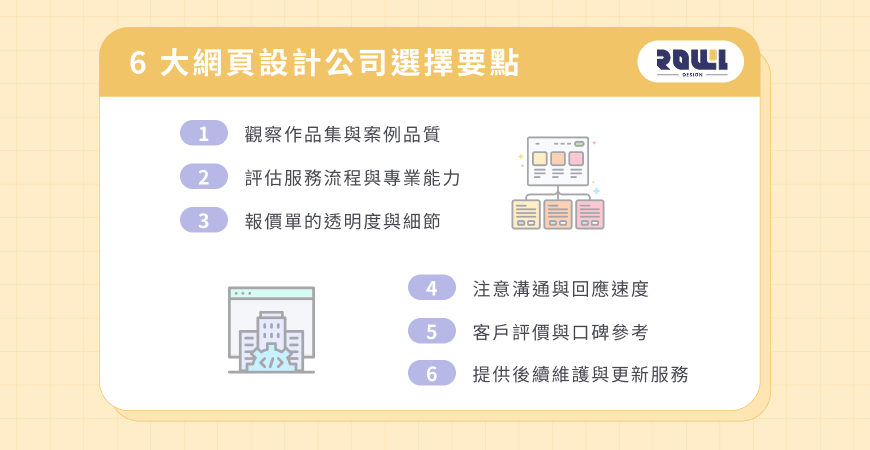
(1) Evaluate the Quality of Portfolios and Case Studies
A portfolio directly reflects a design firm’s aesthetic sensibility, technical expertise, and industry experience. We recommend reviewing the actual case studies available on their official website to determine whether the design style aligns with the company’s or brand’s positioning, and whether the visual presentation is professional and consistent.
In addition to the overall visual appeal of the website, pay attention to whether the responsive design is well-implemented, the layout is clear, and the functionality operates smoothly, ensuring that the work combines aesthetics with practicality.
(2) Evaluate Service Processes and Professional Capabilities
Professional web design firms typically have a clear and comprehensive production process, including requirements interviews, website architecture planning, visual design proposals, programming development, as well as testing and official launch. Each stage should be accompanied by clear planning and explanations, allowing clients to understand progress and deliverables while ensuring the project moves forward smoothly.
(3) Transparency and Detail in the Quote
A comprehensive quote should list design fees, development costs, the number of pages, maintenance items, and potential additional expenses, rather than simply providing a total price. Clear itemization not only helps clients understand the cost structure but also prevents disputes over additional charges later on, safeguarding the interests of both parties.
(4) Communication and Response Speed
Design firms should proactively confirm brand requirements and project details, while offering professional recommendations for client consideration. Additionally, they must respond to inquiries within a reasonable timeframe to enhance overall execution efficiency. If slow responses or vague communication occur during the initial consultation phase, subsequent project execution may be compromised, increasing the risk of schedule delays or mutual misunderstandings.
(5) Client Reviews and Reputation
In addition to reviewing the web design company’s portfolio, you should also consult case studies on their official website or third-party review platforms. Furthermore, it is advisable to pay attention to feedback from the company’s past clients regarding whether projects were completed on time, the quality of after-sales service, and how issues were handled, thereby gaining an early understanding of their actual service quality.
(6) Provision of Ongoing Maintenance and Update Services
Since websites require regular maintenance and updates after launch—including system updates, security patches, and server monitoring—it is advisable to assess whether the design company offers comprehensive post-launch support services. This ensures the long-term stability of your website and reduces the hassle and costs associated with self-management or seeking additional third-party services.
Choose ROLLLL DESIGN LIMITED for customized solutions! Inquire Now
V. How to Set a Budget for Web Design? Top 3 Common Questions About Web Design
Q1: How do I set a reasonable budget range?
When setting a website budget, start by establishing a budget ceiling and evaluating your website’s goals, functional requirements, and future scalability. If the site is solely for brand image display with few pages and simple functionality, the budget can be relatively modest; however, if it includes a membership system, e-commerce features, a custom backend, or a multilingual structure, development costs will naturally increase.
Additionally, you should factor in future costs for website maintenance, feature upgrades, or content updates, and set aside a certain percentage of the budget as a contingency (e.g., 10–15%) to avoid higher expenses from later modifications or reworks.
Q2: Aside from web design fees, what other recurring annual expenses are there?
After the website goes live, ongoing fixed operational costs will still be incurred to maintain stable system operation. These primarily include:
● Hosting fees: These vary based on website traffic and performance requirements and must be renewed annually.
● Domain fees: Domain names must be renewed annually; choosing popular keywords or short, memorable domains may incur higher costs.
● Website maintenance fees: These cover system updates, security patches, backups, and troubleshooting.
● Feature expansion or content update fees: These depend on actual needs, such as adding pages, integrating new systems, or adding interactive features.
Q3: Should I hire a freelancer or a web design agency?
This primarily depends on the project scale and your business needs. If the website has relatively simple functionality and your budget is limited, freelancers can typically offer more flexible pricing and collaboration options; however, you should verify their technical capabilities and ensure they provide comprehensive post-launch maintenance support.
However, if the project is large-scale, prioritizes long-term development and stability, or requires the integration of design, front-end and back-end development, as well as ongoing maintenance and updates, it is recommended to entrust the project to a web design agency with a specialized team structure. This ensures a more comprehensive implementation process and reliable technical support.
VI. Recommended Web Design Company: [ROLLLL DESIGN LIMITED]—Let’s Build Your Website Together!
When searching for the right web design partner, in addition to considering professional expertise, portfolio quality, and pricing transparency, choosing a company that offers a comprehensive workflow and ongoing support will better ensure the long-term stability of your website. We recommend “ROLLLL DESIGN,” which uses tailor-made digital solutions to help your website stand out in a highly competitive market.
ROLLLL DESIGN: Comprehensive Web Solutions
"ROLLLL DESIGN" boasts a professional team covering a full range of services, including visual design, front-end and back-end development, and maintenance updates. We are dedicated to creating websites for brands that combine aesthetics with functionality. Whether it’s corporate branding, e-commerce platforms, or custom projects, we provide expert advice and one-stop solutions to help brands successfully achieve their digital transformation and online business goals.
● Brand Building: From graphic design to complete brand identity systems, we help build a professional and consistent brand image.
● Platform Development: Custom development of corporate websites, e-commerce platforms, apps, and mini-programs to meet a wide range of business needs.
● Digital Marketing: Targeted advertising on Facebook, Instagram, and Google to drive business growth and brand exposure.
● Technical Support: We provide reliable system maintenance and technical consulting services to ensure the long-term stability of your website.
ROLLLL DESIGN: 5 Core Services and Features
✅︎ Customized Solutions: We create bespoke website architectures
and functional designs based on brand positioning and business needs, helping companies establish a distinctive digital presence.
✅︎ One-Stop Server Hosting
: We provide comprehensive cloud server configurations, including data backup, security monitoring, and performance optimization, ensuring excellent website stability and security while reducing the burden of self-management for businesses.
✅︎ SSL Security Certificates
: Encrypt user data with SSL certificates to effectively safeguard personal information and transaction security, while also enhancing the website’s trustworthiness and search engine rankings.
✅︎ Free Professional Domain Registration
Assistance: We help select concise domain names that align with your brand image to strengthen brand recognition, while providing registration support so businesses can quickly establish their online presence.
✅︎ Full-Stack Development Capabilities
: We possess comprehensive full-stack development expertise, covering WeChat Mini Programs, website systems, informational websites, booking systems, ordering systems, app development, ERP systems, and online marketing campaigns. We provide diverse and integrated solutions tailored to various business needs.
Choose ROLLLL DESIGN to create your own website today! Contact Us Now

High Traffic but Zero Orders? 5 Critical Mistakes in "Website Page Design" That Are Causing You to Lose Customers
Is your website getting daily traffic, but no one is requesting quotes or placing orders? The latest conversion rate analysis for 2026 will help you identify 5 critical flaws in your “website design” that are causing you to lose customers. Improve your layout right away and turn that traffic into revenue! ...
Website Page Design , Website Traffic
What Pitfalls Are Hidden in “Web Design Packages”? 4 Real Metrics for Evaluating Hong Kong Web Design Companies
Are “Web Design Packages” Priced at a Few Thousand Yuan Really a Good Deal? We expose common hidden fees and template traps in 2026. We’ll teach you 4 key metrics to properly evaluate Hong Kong web design companies and avoid the hassle of having to redo your website!...
Website Design Packages , Website Design Prices
2026 Corporate Website Redesign Guide: What’s the Difference Between a Custom-Designed Website and a Traditional Template-Based Website?
Does your business need a website redesign? This article breaks down the latest web design standards for 2026 and provides a practical roadmap. Learn why partnering with a professional web design agency that offers custom system development can help you move beyond cookie-cutter website packages and build a high-conversion digital asset....
Website Redesign , Website Redesign , Web DesignHelp you solve company IT transformation challenges,
All types of functional websites/Apps/systems can be created!
If you have any production needs, please contact us,
We will provide free consultation for your needs.
- # Good service ≠ More expensive
- # Professional IT team, improve website effectiveness
- # Proper planning, tailor-made IT solutions
Popular Articles
From Idea to App Store: Your 2026 App Development Roadmap
16098
The 2026 Hong Kong Digital Marketing Playbook: Your Guide to Outpacing the Competition
8772
Beyond WordPress: Understanding What Truly Defines an Enterprise CMS
7077
A Beginner's Guide to System Development: An Overview of the 7 Key Processes, Common Development Models, and Cost Components
5468
Don't let an outdated website make your company seem old-fashioned to customers
4725