I. What Is System Development? What Is SDLC? An Explanation of the System Development Life Cycle
"System development" refers to a series of processes ranging from requirements analysis, design, and development to testing and deployment; whereas "SDLC (System Development Life Cycle)" is a standardized, phased management approach that helps teams systematically plan and execute each development step, thereby reducing risks and increasing project success rates.
(1) What is System Development?
System development (System Development) refers to the complete engineering process of transforming the needs of an enterprise or user—through requirements analysis, architectural design, programming, testing and validation, deployment, and subsequent maintenance—into a fully operational information system.
The 3 Core Objectives of System Development:
Problem Solving: Providing concrete solutions to pain points in business operations or user scenarios.
Meeting Requirements: Building a system that meets functional and user experience needs based on real-world usage scenarios.
Process Optimization: Enhancing overall efficiency and accuracy through automation and system integration.
(2) The Importance of the Systems Development Life Cycle (SDLC)
The Systems Development Life Cycle (SDLC) is a structured, standardized process. Its core purpose is to serve as a "development blueprint," providing the entire development process with clear "steps, standards, and quality control mechanisms." It guides the team from the "starting point (concept)" to the "end point (deployment and maintenance)," effectively reducing the risk of project failure or loss of control.
The 5 Key Benefits of SDLC:
Reducing Costs and Risks: Identifying and correcting issues early on avoids the high costs associated with major modifications later in the process.
Ensuring System Quality and Stability: Enhancing system reliability through standardized processes and testing mechanisms.
Enhance Project Control: Each phase has clear objectives and deliverables, facilitating progress tracking and resource management.
Improving Development Efficiency and Team Collaboration: Clear division of labor and processes facilitate cross-departmental communication and collaboration.
Enhancing Customer Satisfaction: By ensuring the system better meets requirements and is delivered reliably, user experience is improved, leading to increased customer satisfaction and trust.
II. A Comprehensive Analysis of the System Development Process: Understanding the 7 Major Steps
A complete system development process consists of multiple interlinked phases, covering everything from preliminary planning, requirements analysis, and system design, through actual development and testing, to final deployment and ongoing maintenance. Each phase is closely interconnected, and any oversight in any stage can impact the overall quality and stability of the system.
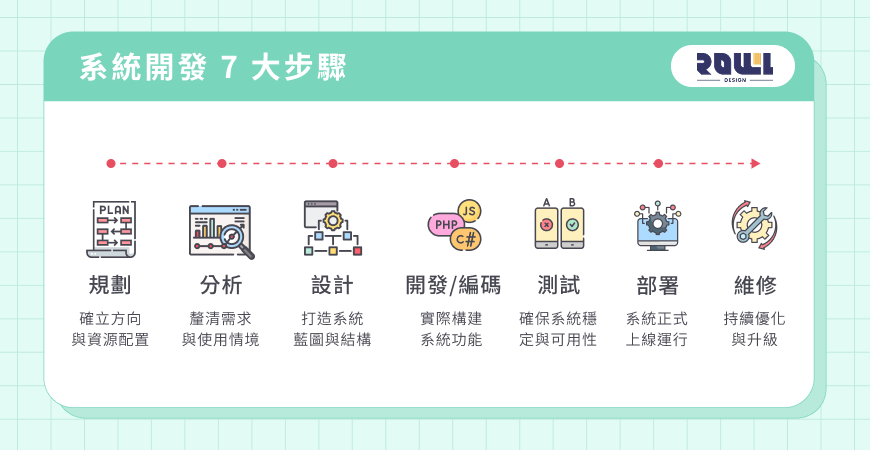
(1) Planning: Establishing Direction and Resource Allocation
Before formally commencing development, comprehensive planning is essential to ensure the project is on the right track and is practically feasible. This phase involves a thorough assessment of technical capabilities, budget costs, and execution timelines. It also includes the preparation of relevant documents such as project proposals, budget sheets, and project schedules, which serve as critical references for subsequent team collaboration and progress management.
At the same time, this prevents the premature launch of development before conditions are fully clarified, thereby avoiding subsequent issues such as wasted resources or deviations from the intended direction.
Key components include:
Defining Project Goals and Scope
Budget and Timeline Assessment
Allocation of Human and Technical Resources
Risk assessment
(2) Analysis: Clarifying Requirements and Use Cases
If we merely focus on the superficial "what the client wants" without further considering "what problems actually need to be solved," it often leads to system features that are flashy but impractical. Therefore, at this stage, we will gain a deep understanding of users' actual needs and usage scenarios, and organize and translate them into concrete and actionable system requirements documents.
Common Tasks:
User Requirement Interviews: Through meetings or surveys, we identify the expectations of different user roles regarding the system.
Business Process Analysis: Map out existing operational logic to identify areas for improvement or enhanced user experience.
(3) Design: Creating the System Blueprint and Architecture
After completing the requirements analysis, we enter the system design phase, where we translate requirements into implementable technical specifications and architectural designs. This phase is akin to “drawing the system blueprint,” determining how the entire system will operate.
Design components include:
System Architecture Design
Database Design
UI (User Interface)/UX (User Experience) Design
API (Application Programming Interface) Specification
(4) Development/Coding: Actual Implementation of System Features
Engineers write code based on the design documents to progressively implement system functionality. This phase is typically the most time-consuming part of the entire system development process.
Development scope includes:
Front-end Development: Responsible for the user-facing screens, buttons, and interactive logic.
Back-end Development: Responsible for handling the business logic, data processing, and server communication that occur behind the scenes.
System Integration: Integrating APIs to ensure seamless communication between modules.
(5) Testing: Ensuring System Stability and Availability
Once development is complete, the code must undergo rigorous inspection and validation. The purpose of testing is to detect potential bugs early and confirm that the system operates stably under various usage scenarios, thereby reducing the risk of major issues arising after deployment.
Testing types include:
Functional Testing: Verifies that the system operates as intended.
Performance Testing: Assesses system response speed and stability.
Load Testing: Simulates the system’s capacity when a large number of users access it simultaneously.
User Acceptance Testing: Allows end users to verify that the system meets their requirements.
(6) Deployment: The system goes live
During the software development process, teams typically do not conduct development and testing directly on the production system but instead operate across multiple distinct environments. Engineers write code and validate functionality in controlled environments to ensure system stability and security.
Among these, the system actually provided to clients or users for operation is called the "production environment," while systems used for development, building, or testing are referred to as the "development environment" or "testing environment."
Once testing confirms that the system is error-free, it is deployed to the production environment and officially made available for public use.
(7) Maintenance: Continuous Optimization and Upgrades
Even after the system goes live, it requires ongoing adjustments and optimizations based on user feedback. For example, this includes fixing bugs discovered after launch, making necessary adjustments in response to environmental changes (such as operating system updates), and adding or optimizing small features based on actual usage needs to ensure the system remains stable over the long term and meets user requirements.
Ready to launch your system development project?
Contact us now! Get a consultation
III. What Are the System Development Life Cycle Models? An Introduction to the Waterfall Model & Agile Models
Different project scales and requirements correspond to different development models, and these models directly influence the project’s execution pace, communication methods, and risk management strategies.
Below, we’ll introduce you to the two major system development lifecycle models: the “Waterfall Model” and the “Agile Model.” This will help you understand the differences between these development approaches and the scenarios in which each is best suited.
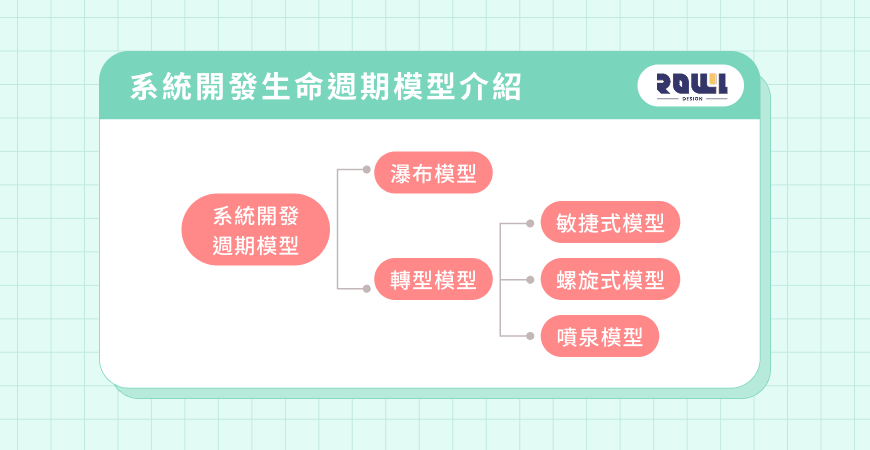
(1) Waterfall Model
The Waterfall Model is a traditional and clearly structured system development process characterized by sequential execution of phases. Each phase must be completed before proceeding to the next, with the overall process advancing step-by-step from top to bottom, much like a waterfall. It typically includes phases such as planning, system design, development, testing, deployment, and maintenance, and emphasizes process integrity and documented management.
Advantages: Clear process, easy to manage
Disadvantages: Low flexibility; higher costs and difficulty for late-stage modifications
Suitable scenarios:
Clear requirements, minimal changes
Medium to large-scale projects, high documentation requirements
(2) Evolutionary Model
The evolutionary model emphasizes a "gradual evolution" approach to development. The system is not completed all at once but grows and optimizes continuously through iterative cycles and incremental feature expansion, adapting to changing requirements and user feedback.
This model is particularly suitable for projects where requirements are not yet fully defined or are expected to change continuously. It allows for ongoing course corrections during development, thereby improving the alignment and practicality of the final product.
1. Agile Model
The Agile Model is a development approach that emphasizes rapid iteration and flexible adaptation. It divides the project into multiple short cycles (Sprints), with each cycle producing a functional version of the system. Its core principles lie in highly responsive adaptation to changes and continuous communication, making it suitable for projects with frequently changing requirements that require rapid market validation.
Advantages: High flexibility, rapid delivery
Disadvantages: Demands high-level team management
Suitable for: Startup projects or mobile app development where requirements are unclear and rapid market penetration is required
2. Spiral Model
The Spiral Model combines the structured process of the "Waterfall Model" with the iterative nature of "prototyping." Prototyping involves rapidly transforming a concept into a functional mock-up during the early stages of product development to facilitate testing and validation, followed by continuous refinement and optimization based on feedback.
Each development cycle sequentially goes through stages such as planning, risk analysis, engineering implementation, and evaluation, gradually expanding system functionality and extending outward within the loop. This model places particular emphasis on risk management, effectively reducing uncertainties and potential risks during the development process through repeated evaluation and refinement.
Advantages: Reduces risk, allows for gradual refinement
Disadvantages: High cost, complex management
Suitable for: Development of complex systems that are large-scale, high-budget, and involve significant technical risks
3. Fountain Model
The Fountain Model breaks free from the constraints of traditional linear processes, allowing different development phases to overlap and iterate. For example, design and development can proceed simultaneously, and testing can be conducted in parallel with development.
Advantages: High flexibility, improved efficiency, and the ability to conduct development in parallel
Disadvantages: High demands on team collaboration and version control
Suitable for: Complex system development projects requiring high levels of integration.
IV. How Are System Development Costs Calculated? A Summary of Common Billing Items for Early, Mid, and Late Phases
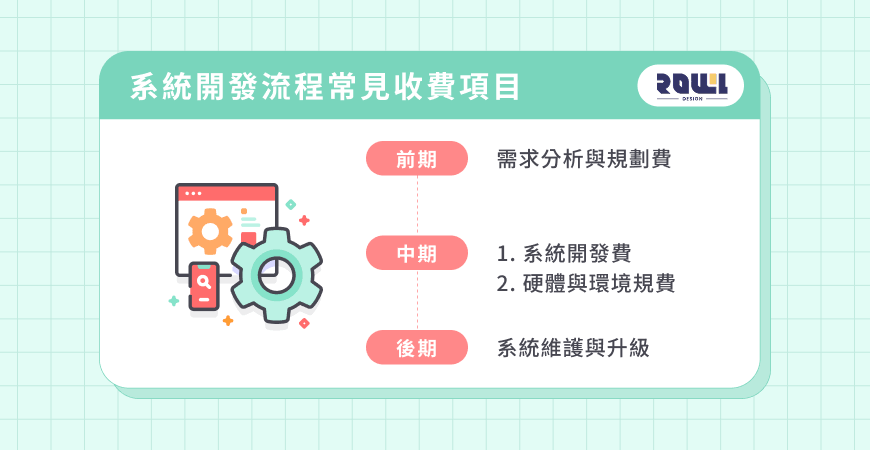
System development costs are not a single fixed amount but are calculated in segments based on the scope of work and resources invested at each project stage. From initial planning to mid-stage development and on to post-launch maintenance, every phase incurs costs. Therefore, understanding the fee items for each stage helps ensure more precise control over the overall budget allocation.
(1) Pre-Development Phase
Before the system officially enters the development phase, the primary costs are concentrated in the requirements clarification and overall planning stages. During this phase, consultants or project managers typically conduct interviews and analyses to help clarify the true needs of the enterprise or users and compile them into concrete documentation.
Project | Scope of Work |
|---|---|
Requirement Analysis and Planning Fees | Includes labor and time costs associated with consultant interviews, requirements consolidation, process analysis, and the drafting of requirements specifications. |
(2) Mid-Development Phase
The mid-phase is the most critical stage of the overall system development and accounts for the highest proportion of costs. It primarily includes design, development, and testing work, and may also involve related infrastructure setup costs.
1. System Development Fees
Item | Scope of Work |
|---|---|
UI/UX Design Fees | Responsible for the product’s “face” and “logic.” Includes creating wireframes (interface flowcharts) and mockups (visual design diagrams) to ensure the system is both user-friendly and aesthetically pleasing. |
Programming Development Fees | ● Front-end (User Interface): Common technologies include HTML, CSS, and JavaScript. ● Backend (Database, Logic Processing): Common languages include PHP, Python, Ruby, Node.js, and Go. |
Testing and Validation Fees | The gatekeeper ensuring system quality. This includes unit testing (checking code snippets), integration testing (checking module interfaces), and pre-launch user acceptance testing (UAT). |
2. Hardware and Environment Fees
Item | Description |
|---|---|
Domain Registration | Purchase a dedicated URL for the system (e.g., www.company.com). |
Web Hosting | Rent server space (e.g., AWS, GCP, or Azure) to ensure the system operates 24/7. |
SSL Certificate | Secure Sockets Layer (SSL) for encrypted data transmission (HTTPS) ensures data security and is a standard feature of modern systems. |
(3) Post-Development Phase
After the system goes live, ongoing maintenance and upgrade costs will continue to arise to ensure stable operation and alignment with actual usage requirements.
Item | Scope of Work |
|---|---|
Bug Fixes | Addressing anomalies that arise only after the system goes live under real-world load conditions. |
Functional Optimization | Adjusted navigation flows for greater fluidity based on users’ actual click patterns and feedback. |
Security Updates | In response to evolving cyber threats, we conduct regular vulnerability scans and system patches to ensure data security. |
Choose ROLLLL DESIGN LIMITED to
 develop a system tailored just for you! Contact us now
V. How to Choose an SDLC Model? System Development FAQ
Q1: How to Choose an SDLC Model?
Different SDLC models are suited for different types of project scenarios. Failing to select one based on actual needs may lead to increased development costs, higher communication overhead, and even impact delivery timelines and the quality of the final product. Therefore, it is recommended to thoroughly discuss with the development team early in the project and select the most appropriate development process based on the project’s characteristics.
When evaluating, consider the following three key factors:
Stability of Requirements: Are the requirements clear and fixed, or are they likely to change over time?
Project Scale and Risk: Is the system a large-scale project, or does it involve higher technical and operational risks?
Development Team Characteristics: Is the team self-disciplined? Are they accustomed to frequent communication?
Q2: How can software development efficiency be improved?
During the system development process, efficiency often directly impacts delivery speed and cost control. By utilizing appropriate methods and tools, overall development efficiency and quality can be effectively improved.
Adopt Agile or Iterative Development: By rapidly deploying and validating small releases in short cycles, issues can be identified and corrected early, reducing the cost of errors in later stages.
Implement automation (DevOps): Automating repetitive testing and deployment tasks with tools not only reduces human error but also allows engineers to focus on core logic development.
Use collaboration tools: Leverage Jira or Trello to manage task statuses, or use Notion to consolidate specification documents, ensuring information transparency and eliminating communication gaps.
Componentization and Modularization: Breaking the system down into reusable components or modules accelerates development, reduces redundant work, and facilitates future maintenance and feature expansion.
Create Clear Documentation: Establish clear documentation and specifications to ensure new team members can get up to speed quickly and maintain consistency, while reducing misunderstandings and the number of revisions, thereby improving overall efficiency.
Regular Optimization and Adjustment: Periodically review the code architecture and development processes, address performance bottlenecks, and optimize the design to accommodate future changes in requirements.
Q3: What are the most common issues encountered in system development?
Even with thorough planning, various challenges may arise during the system development process. If not addressed early on, these issues can easily impact project timelines and final quality.
Common issues include:
Unclear or frequently changing requirements, leading to repeated adjustments in the development direction
Overly complex or illogical system design, increasing maintenance and expansion costs
Incomplete testing, resulting in issues discovered only after deployment
Failure to allow for system scalability, overlooking subsequent maintenance and upgrade costs
Poor team communication or coordination gaps, resulting in information discrepancies and development delays
Therefore, we recommend that businesses implement sound planning, clear communication, and standardized process management to effectively reduce the likelihood of these issues and improve overall project success rates.
VI. Seeking an Efficient System Solution? We Recommend ROLLLL DESIGN LIMITED’s Custom Development Services
After understanding the system development process, model selection, and common issues, it becomes clear that a successful system depends not only on the technology itself but also on the planning capabilities and overall development experience of a professional team. Especially when dealing with customization needs, cross-system integration, or business process optimization, choosing a team with comprehensive development capabilities can significantly improve efficiency and reduce trial-and-error costs.
If you are looking for a partner that combines technical expertise with project planning capabilities, we recommend choosing ROLLLL DESIGN LIMITED’s custom development services to help your business create more efficient, stable, and practical system solutions.
ROLLLL DESIGN LIMITED: Providing Comprehensive System Solutions
"ROLLLL DESIGN LIMITED" boasts a professional team offering a full range of services, including visual design, front-end and back-end development, and maintenance updates. We are dedicated to creating websites for brands that combine aesthetic appeal with functionality. Whether it’s corporate branding, e-commerce platforms, or custom projects, we provide expert advice and one-stop solutions to help brands successfully achieve their digital transformation and online business goals.
Brand Building: From graphic design to comprehensive brand identity, we help build a professional and consistent brand image.
Platform Development: Custom development of corporate websites, e-commerce platforms, apps, and mini-programs to meet a wide range of business needs.
Digital Marketing: Targeted advertising on Facebook, Instagram, and Google to drive business growth and brand exposure.
Technical Support: We provide reliable system maintenance and technical consulting services to ensure the long-term stability of your website.
ROLLLL DESIGN LIMITED: 5 Core Services and Features
Customized Solutions
Based on brand positioning and business needs, we create bespoke website architectures and functional designs to help businesses establish a distinctive digital presence.
One-Stop Server Hosting
We provide comprehensive cloud server configurations, including data backup, security monitoring, and performance optimization, ensuring excellent website stability and security while reducing the burden of self-management for businesses.
SSL Security Certificates
Encrypting user data with SSL certificates not only effectively safeguards personal information and transaction security but also helps improve the website’s trustworthiness and search engine rankings.
Free Professional Domain Name Registration
We assist in selecting concise domain names that align with your brand image to strengthen brand recognition, while providing registration support so businesses can quickly establish their own online presence.
Full-Stack Development
We possess comprehensive full-stack development capabilities, covering WeChat Mini Programs, website systems, informational websites, booking systems, ordering systems, app development, ERP systems, and online marketing campaigns. We provide diverse and integrated solutions tailored to various business needs.
Let ROLLLL DESIGN LIMITED handle the planning and
development of your custom, high-performance system. Contact us today.
High Traffic but Zero Orders? 5 Critical Mistakes in "Website Page Design" That Are Causing You to Lose Customers
Is your website getting daily traffic, but no one is requesting quotes or placing orders? The latest conversion rate analysis for 2026 will help you identify 5 critical flaws in your “website design” that are causing you to lose customers. Improve your layout right away and turn that traffic into revenue! ...
Website Page Design , Website Traffic
What Pitfalls Are Hidden in “Web Design Packages”? 4 Real Metrics for Evaluating Hong Kong Web Design Companies
Are “Web Design Packages” Priced at a Few Thousand Yuan Really a Good Deal? We expose common hidden fees and template traps in 2026. We’ll teach you 4 key metrics to properly evaluate Hong Kong web design companies and avoid the hassle of having to redo your website!...
Website Design Packages , Website Design Prices
2026 Corporate Website Redesign Guide: What’s the Difference Between a Custom-Designed Website and a Traditional Template-Based Website?
Does your business need a website redesign? This article breaks down the latest web design standards for 2026 and provides a practical roadmap. Learn why partnering with a professional web design agency that offers custom system development can help you move beyond cookie-cutter website packages and build a high-conversion digital asset....
Website Redesign , Website Redesign , Web DesignHelp you solve company IT transformation challenges,
All types of functional websites/Apps/systems can be created!
If you have any production needs, please contact us,
We will provide free consultation for your needs.
- # Good service ≠ More expensive
- # Professional IT team, improve website effectiveness
- # Proper planning, tailor-made IT solutions
Popular Articles
From Idea to App Store: Your 2026 App Development Roadmap
16261
The 2026 Hong Kong Digital Marketing Playbook: Your Guide to Outpacing the Competition
8871
Beyond WordPress: Understanding What Truly Defines an Enterprise CMS
7135
A Beginner's Guide to System Development: An Overview of the 7 Key Processes, Common Development Models, and Cost Components
5712
Don't let an outdated website make your company seem old-fashioned to customers
4791