
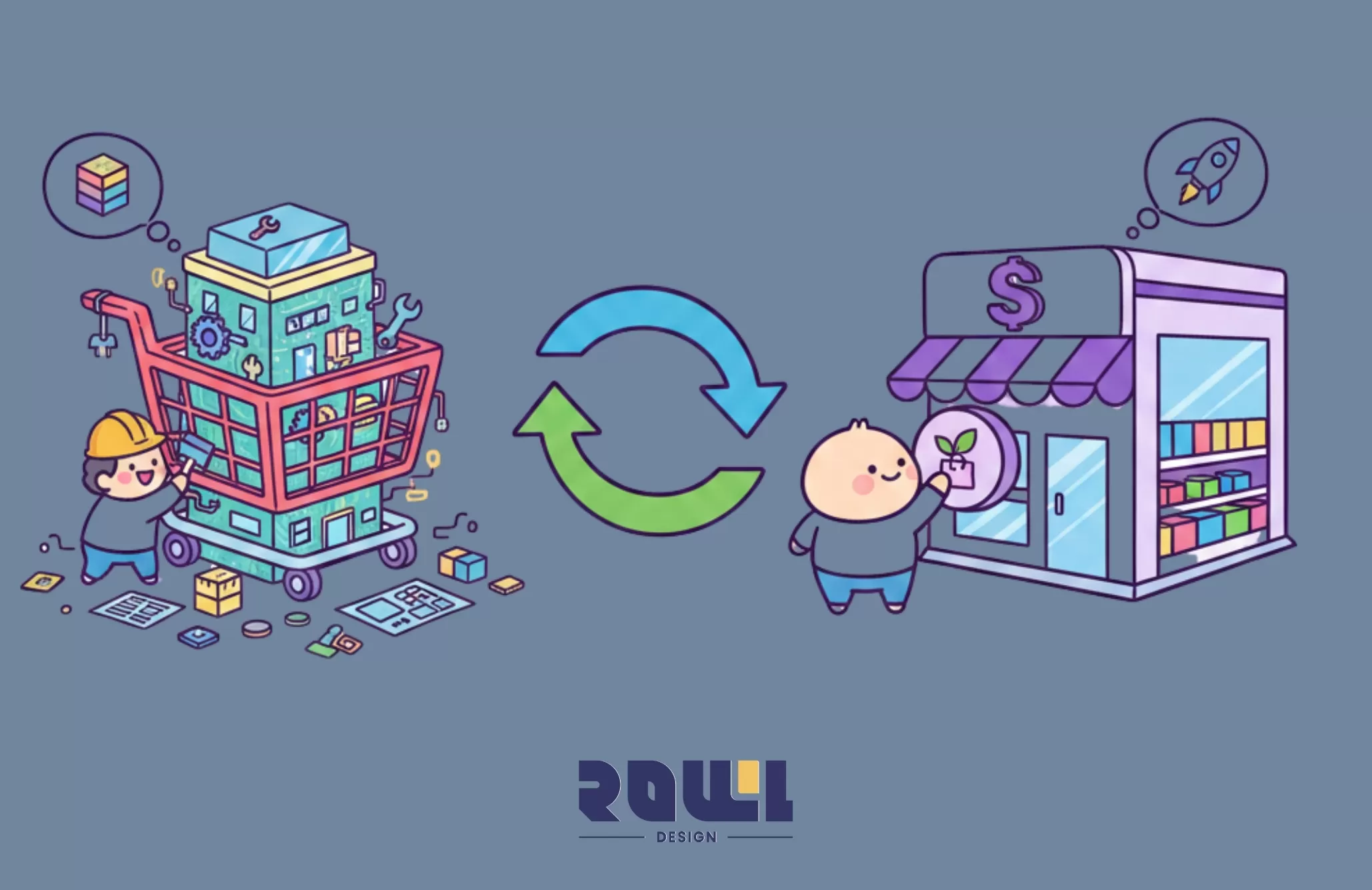
"Starting an online store with Shopify is fast and affordable—isn't that great?"
We've heard this countless times. True, Shopify is like a move-in-ready, fully furnished apartment. At first, you'll be drawn to its speed, convenience, and transparent pricing. But as your business grows, you'll discover you can't knock down walls, can't make major layout changes, and must pay monthly maintenance fees. Worst of all—you're forever just a tenant. This "apartment" never truly belongs to you.
Today, let's have an honest conversation: When your business transitions from "testing the waters" to "building a career," why investing in a fully customizable, truly owned online store will be a decision you'll thank yourself for over the next decade.
Debunking the Myth! What is Shopify's True Nature?
First, we must face reality. Platforms like Shopify and Wix are fundamentally "rental services," not "asset ownership." You pay a monthly fee to rent their system, their templates, and their rules. It's like renting an apartment:
Pros: Quick setup, low initial costs, no server maintenance headaches.
Cons: You're locked into their ecosystem. Functionality is limited to their available plugins; design templates are highly duplicated; and most critically—the lifeblood of your business (data and customer experience) isn't 100% under your control.
When the platform changes rules, raises fees, or doesn't support features you need, you have no choice but to compromise or endure a painful migration.
Fully Custom Store vs. Shopify — 5 Brutally Honest Comparisons
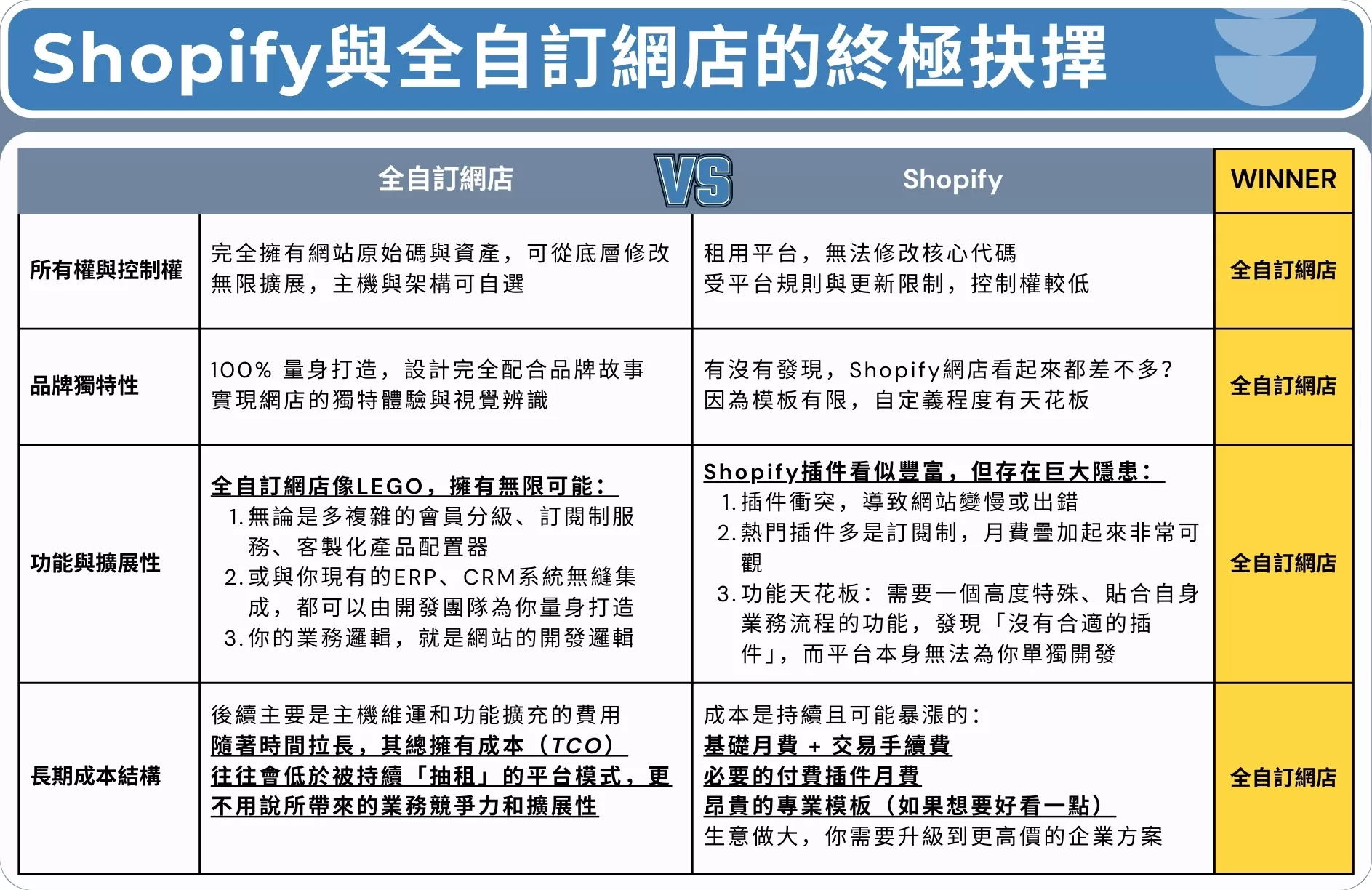
1. Ownership vs. Control: Your "House" or a "Lease"?
Shopify: You rent space. The source code isn't yours, and you can't modify core logic at the foundation level. The platform changes things on a whim, and you just have to adapt.
Fully Custom Store: From foundation to finish, 100% your asset. Source code in your hands, servers chosen by you (like our high-performance solutions for clients). You're the absolute owner, free to expand or remodel as your business demands—no one else's approval needed.
2. Brand Uniqueness: Break Free from the "Template Factory" Clone Army
Ever notice how many Shopify stores look remarkably similar? That's because templates are limited, and customization has a ceiling. Your brand story and unique character struggle to shine within a framework designed for the masses.
Fully custom development means designers and developers can tailor everything from scratch to your brand. Every interaction, every animation, every layout element exists solely to tell "your story." In today's fiercely competitive e-commerce landscape, visual uniqueness and exceptional user experience are your strongest memory points and premium value drivers.
3. Functionality and Scalability: Feeling Shackled When You Need to Run
Shopify's plugin ecosystem appears robust, yet harbors significant risks:
Plugin conflicts: Different plugins may clash, causing your site to slow down or crash.
Ongoing Costs: Popular plugins often require subscriptions, and the monthly fees can add up significantly.
Functional Ceiling: When you require highly specialized features tailored to your business processes (e.g., complex B2B quoting systems or deep integration with unique warehousing/logistics), you'll often find "no suitable plugin" exists—and the platform itself cannot develop custom solutions for you.
A fully custom e-commerce store, however, is like LEGO—offering limitless possibilities. Whether it's complex membership tiers, subscription services, custom product configurators, or seamless integration with your existing ERP or CRM systems, your development team can tailor everything to your needs. Your business logic becomes the development logic of your website.
4. Data and Integration: Unlocking Your Business's Vital Pathways
Your customer data, purchase behavior, and inventory information are your most valuable digital assets. On third-party platforms, the depth of analysis and independent utilization of this data are often restricted.
Own a fully customizable online store, meaning:
Complete Data Autonomy: Build custom analytics dashboards tailored precisely to your needs.
Seamless Business Integration: Deeply connect your website with internal finance, inventory, and marketing systems for fully automated operations, drastically reducing human error and time costs.
Greater SEO control: From site architecture and speed optimization to every tag, you can make extreme SEO adjustments without platform restrictions. This is crucial for long-term free traffic acquisition.
5. Long-Term Cost Structure: Don't Be Fooled by "Low Monthly Fees"
Shopify may seem like a "low barrier to entry," but its costs are ongoing and can skyrocket:
Base monthly fee + transaction fees (Using a third-party payment system? Expect higher fees!)
Essential paid plugin subscriptions
Expensive professional templates (if you want something visually appealing)
As your business grows, you'll need to upgrade to pricier enterprise plans
A fully custom-built store is a one-time major investment, with ongoing costs primarily for hosting maintenance and feature expansions. Over time, its total cost of ownership (TCO) often ends up lower than the platform model that keeps "siphoning rent." Not to mention the business competitiveness and scalability it brings—these benefits simply can't be measured directly by price.
So who truly "fits" Shopify?
To be fair, Shopify is a reasonable choice in the following scenarios:
Genuine micro-businesses/personal brands: With extremely limited budgets, aiming to validate the market at minimal cost.
Short-term, pop-up sales campaigns: Need to quickly set up a landing page for a specific event.
But if you view e-commerce as your core business channel, value long-term brand equity, and anticipate rapid business growth and change, investing in a fully custom solution from the start is almost the only wise choice.
Choices are never based on "how cheap it is now," but on "how much freedom it offers in the future."

High Traffic but Zero Orders? 5 Critical Mistakes in "Website Page Design" That Are Causing You to Lose Customers
Is your website getting daily traffic, but no one is requesting quotes or placing orders? The latest conversion rate analysis for 2026 will help you identify 5 critical flaws in your “website design” that are causing you to lose customers. Improve your layout right away and turn that traffic into revenue! ...
Website Page Design , Website Traffic
What Pitfalls Are Hidden in “Web Design Packages”? 4 Real Metrics for Evaluating Hong Kong Web Design Companies
Are “Web Design Packages” Priced at a Few Thousand Yuan Really a Good Deal? We expose common hidden fees and template traps in 2026. We’ll teach you 4 key metrics to properly evaluate Hong Kong web design companies and avoid the hassle of having to redo your website!...
Website Design Packages , Website Design Prices
2026 Corporate Website Redesign Guide: What’s the Difference Between a Custom-Designed Website and a Traditional Template-Based Website?
Does your business need a website redesign? This article breaks down the latest web design standards for 2026 and provides a practical roadmap. Learn why partnering with a professional web design agency that offers custom system development can help you move beyond cookie-cutter website packages and build a high-conversion digital asset....
Website Redesign , Website Redesign , Web DesignHelp you solve company IT transformation challenges,
All types of functional websites/Apps/systems can be created!
If you have any production needs, please contact us,
We will provide free consultation for your needs.
- # Good service ≠ More expensive
- # Professional IT team, improve website effectiveness
- # Proper planning, tailor-made IT solutions
Popular Articles
From Idea to App Store: Your 2026 App Development Roadmap
15621
The 2026 Hong Kong Digital Marketing Playbook: Your Guide to Outpacing the Competition
8511
Beyond WordPress: Understanding What Truly Defines an Enterprise CMS
6964
A Beginner's Guide to System Development: An Overview of the 7 Key Processes, Common Development Models, and Cost Components
4908
Don't let an outdated website make your company seem old-fashioned to customers
4572